

.svg)
Okay, welcome back, Dr. Jay to the Biohacker Babes. We're so excited to have you back on the show. How's it going?

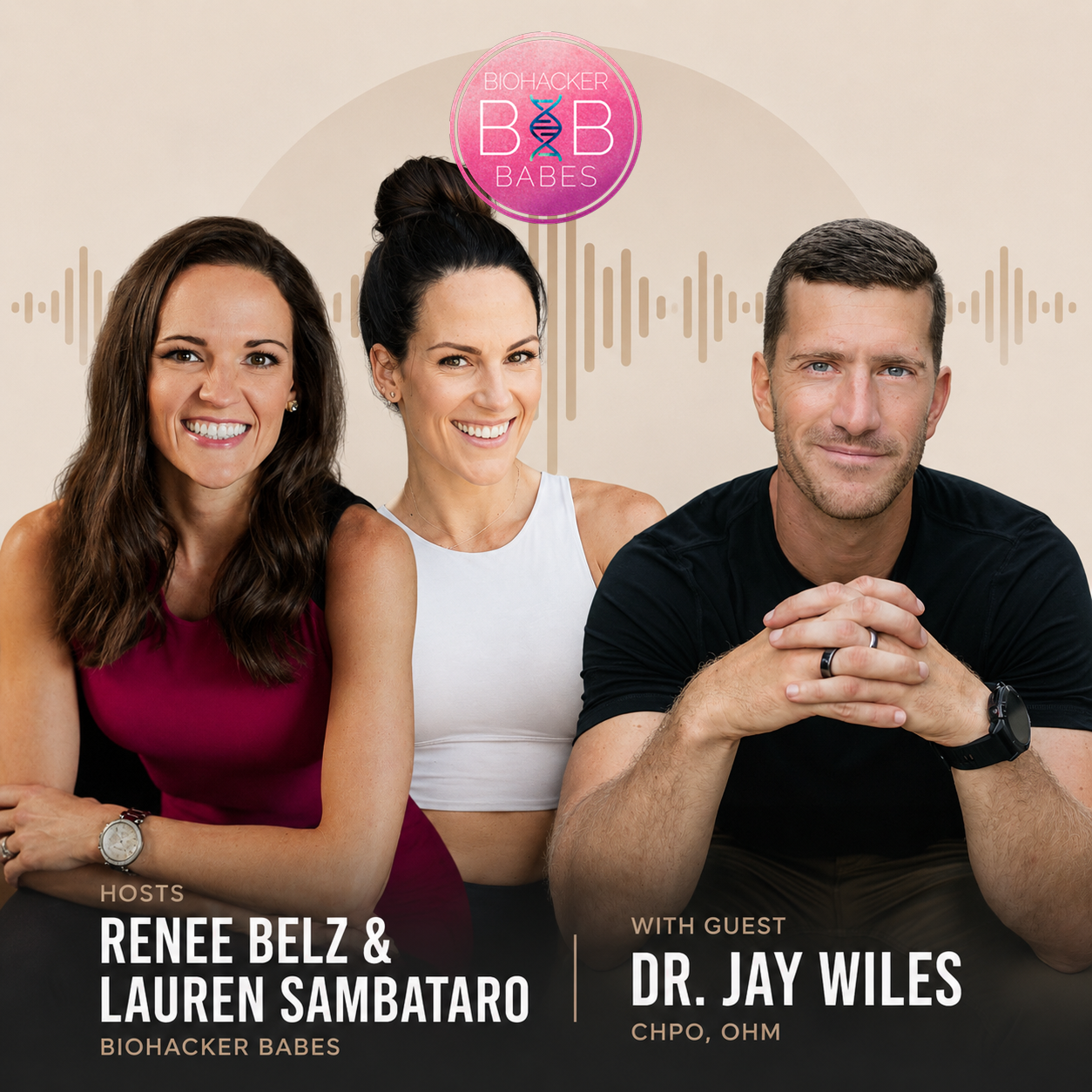
Dr. Wiles breaks down the role of the vagus nerve and shares how Heart Rate Variability (HRV) can be used as a personalized metric for resilience and recovery. The conversation dives into resonant breathing, how to find your optimal breathing rate, and why comparing your HRV scores to others can be misleading.
Listen or Watch On
.jpg)
Dr. Jay Wiles
Lauren Sambataro

Renee Belz
Episode Chapters
Jump to transcript ↓Key Takeaways
Transcript
Okay, welcome back, Dr. Jay to the Biohacker Babes. We're so excited to have you back on the show. How's it going?
Oh good. This feels like the the good old days. I feel like I've taken like a break from the the podcasting sphere for a little bit of time. So glad to be back and to be back with you two.
Hey, you've been a little you've been a little busy, so we're gonna share some of your latest insights and work on the podcast today. For anyone that is not familiar with who Dr. Jay is, we used to do roundtable podcasts together. We've had you on solo episodes to talk about heart rate variability, one of our favorite biometrics in the world. You are our go-to HRV expert. You have been in this space for like 15 plus years.
Way longer than anyone has ever even heard the term HRV.
You're making me feel old though, Renee, when you say that.
Just progressive.
Sometimes I say I've been biohacking for like 30 years. I'm like, well that makes me feel old.
I know, I know.
We started young.
So how long were you not biohacking for?
Yeah, less than that.
Right.
So yeah, so we're excited. We're gonna talk about HRV. We are gonna debunk some myths and misconceptions because that is just constantly happening, especially in the world of social media today. It seems like vagus nerve is trending. HRV is a little bit trendy as well. And you even call these people, these...nervous system drifters, I think is what you've said?
Grifters, yeah, grifters.
Thinking about F1 in my head. Grifters. So many people are talking about this online, but they're promoting a lot of these what you call passive tools. Like use this device for 10 to 15 minutes a day. Your HRV will improve by 300%, right? There's like these crazy claims. So I want to jump into, first of all, why do you think these passive tools are not the answer to increasing this nervous system resilience?
Yeah. I wish they were. I mean, that's the thing. I really wish they were. Yeah. I mean, it would be so easy if you could just passively have something stimulate the vagus nerve and then it eradicates your stress response, eradicates anxiety or depression or improves mental and emotional well-being. I wish it it wish it did. If that thing was out there and I saw the evidence and the data, I would fully support it. I would throw my time and my money and my effort behind it. It's just not telling the complete picture.
And honestly, that is what gets me more frustrated than anything. It isn't that people are selling products intended to help with things like mental resiliency and nervous system resiliency. Like, great! I'm a part of that as well. So I can't be completely mad at that. I think it's when they approach it and use language that isn't substantiated or doesn't give like a mechanism of action, right? Like, that's another thing for me as an academic and scientist at at heart and by trade. It's that, when someone makes a claim that they can't then back up or substantiate with some form of evidence, or if the evidence is just coming from their own internal research and not from something that's kind of outside of their company or their own interests, then I become a little bit more skeptical and frustrated. You guys are the same way.
You go to a lot of these conferences and, I was thinking about like last year I went to a conference in November in Florida. And it's one of the largest health and wellness conferences. I'm not gonna name it, but last year in November in Florida. And I was there, and everybody kind of hangs up their shingle, all the companies are kind of within their space. And I had these conversations with these people there who are just they're hurting, like they're suffering. They're like, the reason I'm here is because I'm seeking some solution.
And for many of them, it is nervous system dysregulation and compounding stress and difficulties with anxiety and mental health and emotional wellness. And many of them are like, I heard stories of like I'm here kind of on my own dime. I don't have a lot of money to spend. You contrast that with maybe some of the other people who are there who are just like health and wellness individuals who are very affluent and they can afford anything. It doesn't matter if it's $2,000 here, $2,000 there. They can do it. And there's a big delta between those two.
Who I like to concentrate a lot on is the one who's like, I don't have much. But I'm here. And so when I see that, to kind of bring this back full circle, and I see other people and other companies, I should say, who are selling products and making claims that this is the solution, this is the thing, and it's some passive approach that isn't well validated, like my heart really does go out to those people. And I feel so bad and mad at people taking advantage of other people. So I've kind of been setting out a war on social media, if you will, towards these nervous system grifters that I call them, because they are holding up their shingle and saying, hey, this is the thing, this is the solution, this is the product, And to be fair, many of them may not actually be intending to do it with malice or have a nefarious approach to it.
It's just that other people, if you're just scrolling through social media and now you see this 30-second clip of how this thing is going to be the end-all-be-all solution for your nervous system and for your vagus nerve, you're gonna buy into it. Because again, back to my first statement. If it was true, I'd love it. I wish it was true. It just tends not to be. So I think that, right now, I'm just kind of in a position where if I see it, I want to call it out. In a very like gentle, like grateful way, but also in a way of saying, like, if you want to learn how to truly make adaptations in the nervous system, I'm sorry to say it's not gonna be this $500 vagus nerve stimulator that you throw on your neck or you put on your ear.
Or it's not gonna be this thing that vibrates on your wrist or your ankle. Those things could be helpful. And I don't want to take away from something that actually does make you feel subjectively better, but the thing that's going to eradicate or solve your stress problem or your anxiety problem, not likely. Sorry, that was a bit of a rant. That was like a tirade that I went on.
We like your rants and tirades and your your gentle outrage on Instagram. I've been like, hell yeah, he's going for it. Tell the people, because when that passion and that outreach comes through, you know there's something really important to say underneath of it. So we're really excited because you are the expert here. I agree with you. I don't think there's malice or ill intention, but you know, there's trends in the health space. So right now everybody is talking about the vagus nerve. Have you heard about the vagus nerve?
But we can do X, Y, and Z, stick your finger in your ear, hum, gargle, all these things, which I don't think there's anything wrong with. You're not gonna hurt yourself by gargling and humming more. That's probably fine to practice. But this trend of the vagus nerve right now, and I want to get into HRV for anyone that's new here or hasn't heard you speak on our podcast, but...A way into this I want to share with you that I went and did a cadaver dissection recently. Open up the body.
Wow, just like for fun? Was this just like hey, weekend, rainy weekend, let me go, like, open up a body.
Educational curiosity. I've been wanting to do one for well over a decade. So I got to get in there and see everything that I've seen in the textbook. I got to see in front of my face. It was a wild experience. But it was really funny because my instructor who has been doing dissection for 30 years, five days a week, this is his life. He just has his face in dead bodies. It's crazy He was like, why is everyone obsessed with the vagus nerve? Like as someone that knows literally everything that exists inside the body.
He was like, I just don't understand. It's just like another nerve and it's not even called the vagus nerve from top to bottom. The name changes actually. He was like, what what is this obsession? So, can you talk to us about maybe why the nervous system is important and why vagus nerve is so trendy? What's real? What's not? What do we need to know?
Yeah, it's really interesting because if you think about it from someone who might just be looking at kind of like the anatomy, but not necessarily the functionality and thinking a lot about the interconnection of functionality. Then it could just be like, hey, isn't it just like another like body part, just like another organelle system and I think that they could be you could reasonably conclusion. I think the reason that the vagus nerve is so intriguing for people right now is because of the connection that people are making.
with the vagus nerve and autonomic nervous system regulation and how that relates to our stress response. And how that relates to our mental and emotional well-being and even how it relates to things like mental acuity and cognitive performance So it's a very powerful branch of nerve systems. And I think that, because of that, like people are saying, well, it sounds like it's probably something that I can hack. And you know, I use the word hack loosely, but I think a lot of people are thinking hack in terms of like, well, what can I do to stimulate it or to upregulate it, downregulate it, and what can I do to tweak it?
Or cheat the system, perhaps, sometimes?
Exactly. And it's not necessarily an unfair question. It actually is a quite fair question. We as humans are always seeking like Occam's razor. We want to find out what is the most simple thing that we can possibly do, preferably passive, because if we can not have to like concentrate or think about it, like why wouldn't we attach to it? The problem is that it's not that simple. Like again, I wish it was that simple to kind of hack it. But back to the question of why the vagus nerve is so important is because we found out it's a pretty valuable branch of nerve systems.
And so we think about the vagus nerve just kind, like I say vagus nerve, but it's actually a branch of nerves. And vagus actually means wandering. Wandering because it wanders throughout the entire body. So it starts within the spinal cord and is connected to our central nervous system, our brain and spinal cord. And then wanders or peripherates out to the periphery, which is basically all organelle systems. But it's very closely linked or tied to certain organ systems, predominantly the heart and the lungs, but also very much connected with the gut as well.
And the reason that it's so important is that the vagus nerve sends most of its information bottom up. In other words, it takes information more from the body, about 80 to 85% of it, and the signal goes up to the nervous, to the central nervous system, so up to the brain and spinal cord. So that means that when we have changes, let's say in our heart or changes in our lungs, a bulk majority of that information is being sent up to the brain. The brain then takes that information in and says, okay, now I understand what we need to do.
The blood pressure signals are kind of up. We need to lower those things down. We don't want blood pressure to get too high, or vice versa. Oh, you're slowing down your breathing? Oh, we need to make changes all throughout kind of the rest of your periphery. So the vagus nerve is that communication pathway. It's that highway. And it used to be thought we can't really do much to direct or change that signal. And now what we're finding is that's actually not the case. We actually figured out that we can indeed change that signal pretty heavily.
And here's one of the things to kind of make a make a callback to the first part of our conversation in regards to the vagus and kind of these vagal nerve stimulators. Most of these companies are purporting that what we're doing is that we're stimulating the vagus nerve, whether it's through the kind of the lateral parts of our neck or through the ear, and we're sending the message or the signal down to our cardiovascular system and then to our periphery. And that flies in the face of what I was just saying is that most of the signal from the vagus nerve isn't that direction.
It isn't from top down. It's from bottom up. So if it does have an effect, let's say vagal nerve stimulators are having effect, which there is literature to suggest that it does have an effect. And we can talk about that more. The signal isn't super strong to begin with, because only 20%, if not less, of that communication pathway is going in kind of the wrong direction. We actually want more of the direction to go upward. And that's where, like kind of for again more bias in my background, things like resonance breathing or doing breathing or breath regulation practices are actually much more impactful for making strong changes into vagal functioning than doing things that are top-down because again, it's just a much stronger signal going up than it is going down.
That's awesome and so clear and I don't know how we can forget that now because maybe people have heard afferent and efferent and it's like, I don't know which way is it going. But that makes sense.
We gotta start lower.
Yep, you got it. Start bottom up. And it's not to say that there isn't efficacy of top-down processing type of approaches or interventions. It's just saying that most people don't have the physiological capacity to start there. They need to start bottom up.
Okay. That makes so much sense. Okay. I'm glad you explained it that way. So with resonance breathing, that's really where it shines, right? Because that's approaching it from that approach.
But before I even jump into the breath work there, can you explain what the tie-in is with heart rate variability and the vagus nerve?
Because HRV is also trending.
Yeah, it's an important connection to make because most people are gonna go onto their social media outlet and someone is either gonna make a post about this or a company is gonna say, hey, this so-called device affects vagal functioning, and the way that we know it's affecting vagal functioning is through looking at changes in heart rate variability. So there's the connection. So people say, okay, well then how does HRV relate to [vagal functioning] in and of itself? And what I like to say is that, you can think about HRV almost being like a very indirect way at looking at the stability of your vagus nerve.
So the vagus nerve isn't the only nerve that's involved in our autonomic nervous system. There's another nerve that doesn't get talked about very often, but it should be which is the glossopharyngeal nerve, which is also very important in our autonomic nervous system. But the predominant main kind of heavy hitter, if you will, like the Superman of the nerves, is the vagus nerve. So how are these two tied together? Maybe it's helpful then to kind of even take a step back and just give a small short refresher on heart rate variability.
So HRV is the single greatest proxy that we have for looking at how your nervous system is either adapting or not adapting. In other words, is your nervous system showing signs of stability that we're holding in there? Vagus nerve is working strong, doing its thing, holding things kind of stable in your environment, what we would call homeostasis. Or are things being a bit dysregulated? The nervous system's not very capable at that moment in time of handling the stressors that we're encountering. Because if we think about our nervous system, like what is the whole goal of our nervous system?
It's just to keep everything stable. It is constantly receiving and sending messages, because it's a pathway of messages, to say, is the environment right now safe, stable, relaxed, in a good position, capable? That's what we want to have. Or on the opposite. We want to know that. Like we want to know if the opposite is true. And it's like uh-uh, all systems go, threat involved, we have things that we need to kind of take care of. So let's mobilize all of our energy. We would refer to that as our stress response or the fight or flight response.
HRV just gives us a way to kind of quantify that. Like are we kind of in a nice stable position in terms of our nervous system functioning or not so much? And it's just looking at your heart rate and how the successive differences between heart rate time, how they're changing versus not changing. The vagus nerve we know, when it's really active, we actually see that it can cause heart rate to jump really high and really low, really high and really low. And most people would say, do you want your heart rate like going up really high and going down really low?
Like that doesn't sound like we would want it. We would want it to be more stable. And the it's kind of counter. No, like you actually want there to be a lot of variability in your heart rate. Why? Because we are a system, our body is a system, our cardiovascular system is one that is constantly trying to attune to its environment. And so in order to do that, it needs the heart rate to speed up. It needs it to slow down. And our breathing naturally causes that process to happen. And what's at the center of that? The vagus nerve.
The vagus nerve, or what we call the vagal break. So again, when we think about breathing, when we inhale, the vagal break actually lets off and the and the heart rate goes up. As we exhale, the vagal break comes on and heart rate drops. So we create these nice little sinusodal swings in our heart when we're breathing and so the time differences between heartbeats will vary across that cycle as we breathe in, our heart rate gets closer and closer together because it's speeding up. And then as we breathe out, heart rate gets further and further apart.
And so that variance across that cycle is mediated by our vagus nerve. It's controlled by our vagus nerve. And that's what creates heart rate variability. So when someone's looking at, let's say, heart rate variability across time, if we see that there's really good stability from day to day, it doesn't change that much, it's actually holding true to itself. That's a good thing. Like that's actually what we want because the nervous system is stable. It's holding things right where they are. But if we see a reduction over time, let's say three, four, five days, especially a week and onward of this downward trend of heart rate variability, we know that the vagus is actually struggling to keep up.
There's something in the environment. It could be psychological stress, physiological stress due to overtraining, overreaching. And so because of it, the vagus is like, I can't really keep up with this. And we see that reflected in heart rate variability becoming reduced over a period of time. And then that's where we're saying, okay, well how can we include interventions to help stabilize that system to get it back to homeostasis, back to its baseline. And that's where we can start to bring in things like resonance breathing or other more kind of evidence-based strategies for nervous system regulation.
Very cool. Yeah, I just love this. Well, I love the gas pedal, brake pedal analogy. It just makes so much sense. Like we're not trying to do one or the other all the time. We want that balance. We want to be able to respond to our ever-changing environment. I think of soccer players and like agility training. You gotta be able to respond and move quickly and adapt. That's really our goal to be resilient. I have so many questions. What is the most important right now?
Well I thought with HRV maybe we can do a quick snapshot of not comparing your number to other people. And then maybe some of the factors like genetics, height, sex. You know, what what are some of the other things with that number? Because I think people are still comparing HRVs online.
Yeah, yeah. Dispelling some of the myths, I think, it's one of my favorite things to do because I think that like people just aren't privy to that information or they hear it and they forget about it. And so I always like to kind of drive it in and make it clear. I think it's a good idea.
Or we're just inherently competitive. You know, people hear, "it doesn't matter, you can't compare." But we do.
Of course. Yeah. And the thing too that gets perpetuated is that when you look at every other type, not every other, but most other biomarkers, is that you have like this norm of comparison, right? It's like you can see, hey, on this list, like here's this spectrum, and here's kind of the low end, here's the high end, and here's where you need to be which is somewhere right in the middle. And you have that for so many different markers, right? Whether it's cholesterol or blood pressure or just like inflammation markers.
Like you've got these things. And you don't have that for HRV, so it makes it very confusing because people like have that as a mental heuristic, right? They think, well, every other metric puts me kind of like in this range, and they say, here's what's normal. Like, what is normal for HRV? And there is a range for people that is normal, but it's only normal for them. And that's where it gets a little confusing, because it's like, well, Renee's range and what what is considered normal for her HRV is gonna look very different than what yours is, Lauren.
It's gonna look very different than what mine is. And so because of that, you have to know where your normal range falls. Which is why I tell people...If you were to come into my office and I were to throw an EKG on you and we ran five minutes worth of data and you said, all right, Jay, what do you know about my nervous system and my HRV? I would say, I know what the absolute values are for what I just took. So I can tell you the RMSSD or the time domain value there was 50 milliseconds. I can tell you the power domains.
But outside of that, that's about it. I can tell you what your numbers were. But how that compares to your normal baseline, I have no idea. But if you came in every single day for two weeks and I collected that data, I can give you some more information regarding your nervous system and how it's trending, how it's adapting versus not adapting. I can give you a way more in-depth explanation and interpretation of your nervous system. And so that's the one thing that I tell people too. So that's more of a kind of like a, I'm combining two myths here.
Now one is that we're gonna talk about why you don't compare other people and I'll get a little bit deeper into that here in a second. But the other myth that I'm kind of talking about right now is that a single snapshot of your HRV is almost meaningless. I won't say it's completely meaningless, but it's almost meaningless. Especially if you have no context or you can't compare it to anything, right? Because it's like, let's say, for instance, Lauren, you came into my office and you were running really late. Right?
It was like, oh my gosh, like I'm running late. The traffic is horrible. You just ran upstairs and I'm like, all right, Lauren, sit down. Like I'm gonna take your blood pressure and heart rate variability. Probably would look very different than if you came in and you're like, man, I was 15 minutes early. I was sitting out into the lobby, just like, you know, listening to some cool, chill music. And then I kind of slowly wandered in. Your nervous system would look very different. So I can't make an interpretation off of that one single data piece because I don't understand context and the the EKG doesn't understand context either, which is why it's so incredibly important to to pack these in.
Yeah.
It's like fasting glucose. People are like, oh my morning fasting glucose is this. I'm fine. I'm like, what?
Completely meaningless. There's no story that's being told. Totally. It's one piece of the puzzle.
The puzzle can be quite large
Exactly. And then comparing to other people, this is the the biggest challenge that I have. I'll be really quick with my explanation here, is that there are so many factors and variables that make up this number that is heart rate variability, that comparing from one person to another is really comparing apples and oranges. Because we know that even, there's studies to kind of back this up as well, even individuals who have the highest markers of health don't necessarily have the highest HRV. I've worked with Olympians who are like gold medalists.
Like they have all the resources in the world for nutrition and diet, I'm sorry, nutrition, exercise, sleep. They've got it all. But for them, genetically, their HRV is just a bit lower. Like it's it's just not as high as like some other people. And I've seen people who come in with COPD and cardiovascular disease have been chronic smokers all their life and will have higher baseline heart rate variability than that individual who is an Olympian. And people say, well why? It's because HRV is not a vanity metric. It's not a metric of overall health and wellness.
So we can't use it as a health and wellness indicator that then we compare to other people because we're gonna be deeply like fooled and tricked by that and become very frustrated, right? Because it's like, well, I see my...
Disappointed.
Yeah, very disappointed. And so what I tell people is that again, you cannot...You were dealt the genetic lottery that you were given, like the cards that you were given in your genetics. Sorry, it it is what it is. And again, we always go back to this. It's like just because you have the loaded gun doesn't mean that the trigger's gonna be pulled. But when it comes to heart rate variability, we know that there are some genetic factors and variables that just result in a person having a less of a higher baseline in HRV.
Like there's a gene that, I can't remember what the gene is, but it's implicated in overall heart size. So the size of your heart is regulated a lot by this gene. And we know that the individuals with that gene who have larger hearts actually have lower heart rate variability. And so because of that, is that indicative of your overall health status? Not really. We know that women were kind of dealt an unfortunate card with heart rate variability because they tend to have lower heart rate variability than men. And that's almost always explained though by 28-day cycles.
And because women go through 28-day cycles, we know that this fluctuates heart rate variability a lot more than men who typically will hold it stable across a month when they're in a good degree of cardiovascular fitness. So, stop comparing to other people, that's the biggest thing. And then stop taking one-time readings and waking up in the morning and seeing your Oura score or WHOOP score and thinking that this is the end of the world or now you need to make this dynamic decision regarding your training just because of one single reading.
It's doing yourself a huge disservice.
Yeah. The trends are just so important. And that's what's so fun. We've had our Oura rings for eight years, and it's so cool to just be able to see over time what's happening. But also I'm really glad what you mentioned about women because the fluctuations can be wild. The final week of my cycle, my ability to bounce back from a poor night of sleep or a late night out or a hard workout, it just sucks. It just sucks. And then right before ovulation, I can do whatever I want and my HRV is like, we got you. So just knowing that fluctuation, because I think women that aren't aware of that, they might see their HRV totally drop off and they don't understand why.
And then they get mad at themselves. But it's like, no, that's normal.
Yeah, exactly. I've been on other podcasts where I've said, it's like again, when you are...if you're a woman and you're in these different phases of the cycles where we know that hormones are very different than your typical baseline. When you almost see it as, oh, this is a problem that I need to solve for right now. And they try to solve for it and they see that it doesn't really move the needle because they're fighting a very difficult uphill battle against their natural hormonal cycles. It becomes so frustrating for them.
And then, what do they want to do? Well, they want to throw the baby out with the bathwater and say, well, HRV is a sucky metric or my Oura ring is, you know, s***, let me throw it out. I don't want my WHOOP anymore. And they just kind of give up on it. And so again, everything in context. It doesn't even matter if it's heart rate variability. It's all that data that we're collecting: sleep data, heart rate data, HRV data, glucose, everything within context, please.
Yes.
Yeah. Yeah. We're trying to understand the story that the nervous system or the physiology is telling. That's really what we're trying to understand. Yeah, the snapshots are crazy. So I want to get into resonance because you teased that word, the state of resonance and also the technique of resonant breathing. Can you explain what resonance is? I'm sure most people have no clue what that is.
Yeah. The people who are gonna know what resonance is, is actually like engineers. Resonance is an engineering term, but it's applied to our physiology. And so when we think about resonance, what we're doing is we're talking about natural cycles or rhythms that are in synchrony with one another. And so kind of a good way to think about this is, let's think about if anybody's ever pushed a kid on a swing. So if you push a kid on a swing and you choose, let's say, to exert a lot of force at the wrong time...so let's say they don't get to the apex of their backswing, but maybe like halfway up, you try to exert a lot of force.
Woo, not gonna go well, right? It's gonna shake and everything's not gonna be smooth. It's gonna be really difficult to do. And so that right there is actually a sign of like not resonance. Things are not in synchrony. So me pushing, and that kid, I'm just thinking about my my eight-year-old right now, if I push him at the wrong time, things are gonna get really out of the whack and the system's not gonna perform very well. The biggest thing is that I'm just going to exert way too much energy to do this and I'm not going to be efficient at all.
So if I'm pushing my kid, I'm like, oh, sorry, I can go five minutes instead of 30 minutes pushing you because I'm not being efficient with it. However, if I were to wait and say, okay, I can feel the apex of his swing. I'm gonna now let my arm follow. Okay, he's coming back up, apex of his swing, push through. I can get him going way higher in a way more efficient way. I can use 50% less energy in pushing that kid and making him be in a nice rhythm and his swing all in one That's a sign of resonance. It's two systems that are in synchrony with one another at the exact same time.
So, how does this then apply to our physiology? Well, we actually have natural resonance states in our system. So these are natural synchronized systems that we have. The one that's most easily kind of identifiable is the system of respiration and cardiovascular functioning. So the connection between our lungs and lung functioning and respiration and what it does to actual heart rate or what it does to cardiovascular functioning. And then within that, we know that those two are interconnected. And how are they tied?
The vagus nerve. The vagus nerve is sending signals back and forth to the central nervous system that kind of links those two up. And the way that we speak about resonance, what we're talking about is when those two systems start to become in synchrony with one another. And the thing is that, when we become quite stressed, when we are in a state of this chronic sustained stress, those systems actually tend to disconnect from one another in a pretty significant fashion. So they're not working in synchrony. So the whole idea is that, can we force function them to get back in sync within one another?
To get into a place where they're actually working together in harmony to create better homeostasis in the body. And this is the way that we learn how to regulate the nervous system. So resonance, or what we call resonance frequency, is when we start to breathe in line with our heart rate functioning. So back a little bit ago, I talked about this whole idea, you know, again, the brake pad and the gas pedal. And as we inhale, heart rate goes up. And as we exhale, heart rate goes down. And again, a lot of that is mediated by the tenth cranial nerve or vagus nerve.
So when we do that process of creating that big peak and troth differences in heart rate, what we're actually doing is we're exerting changes on blood pressure as well. So as we inhale and heart rate goes up, our blood pressure will rise. And during that process, we actually know that the brain will receive a signal that, uh-oh, blood pressure is rising too much. So therefore we use a-- there's a process called our barrow reflex response that will then send, it's like a negative feedback loop, it'll send a signal down to say blood pressure is getting too high; let's lower it.
And that works almost like a seesaw effect. And the whole reason for that mechanism is to keep things stable. So when we start to engage in what's called resonance breathing, we're aligning these three systems. Our respiratory system with our cardiovascular system and the ability to manage our blood pressure. Every human actually has what was called a resonance frequency breathing rate. That breathing rate is the breathing rate that will stimulate that response at its highest level. And the way we know this is working is through inflation of HRV.
We'll actually see in real time heart rate variability increase. And for some people, it can be almost orders of magnitude higher. I'm not talking about like 10% higher HRV within a span of a couple minutes. Sometimes we can see it go 50%, 100%, 200, even 300% in real time. Now I don't want people to confuse that and say, okay, so if I do resonance breathing, then every night on my Oura I'm gonna start to see like this 100% increase in HRV, 200%. No, it will not happen. These are very transient effects, but can have compound--not can have, will have--compounding long-term effects the more you do it.
So resonance breathing, that optimal number is that we know it's as low as four and a half breaths per minute to about as high as six and a half breaths per minute for adults. And then it goes higher for kids because kids have to breathe at a higher respiration rate. When we find that resonance level which can be different for everybody, it is different for everybody, holding yourself at that level is the way to maximize the connection between the cardiovascular system, your respiration system, and your blood pressure regulation system.
And so what we do is we start to create these really beautiful sinusodal waves in our heart. And what happens is, if you were to overlay and look at breathing or respiration, if we could trace that out and we could trace your heart rate pattern out, we would create synchrony between those two. So respiration and heart rate would be 100% in alignment or pretty close to alignment with one another. What we're doing there is we're creating efficiency and that ability, that baroreflex response that was talking about earlier, the ability to regulate blood pressure.
And over time, we know that the ability to regulate blood pressure in real time and self-regulate, it's basically like cruise control for the body. It keeps things quite stable. And what I always like to tell people is, when you become dysregulated, it's kind of like everybody always has cruise control of blood pressure. But some it's just way better and more efficient than others. So a really dysregulated nervous system would look like this. It's like the old school, like back in the nineties when they first created cruise control or 80s, whenever that was.
Where it was like, it worked, but it wasn't very smooth. It's like, the car would lose like 10 miles per hour and then it would jolt and have to speed up really fast or slow down. And now you contrast that with the cruise controls that are in modern day vehicles, you don't even realize it's doing it. It's so smooth, it's so efficient, everything's just kind of operating. We've got this adaptive feature where if like the car in front of me slows down, it just knows what to do. That is what resonant frequency breathing teaches you to do.
It teaches your nervous system to be on that immensely efficient control system so that when things happen, s*** hits the fan, things go wild, it jumps into high gear and keeps the nervous system regulated. There's not a lot of this stop-go jerkiness that we have. That's when the nervous system is quite dysregulated. So to kind of tie a bow on this one, because I know I've been going for a while, resonance breathing is really intended for two things. Acute changes in the nervous system in real time. Great, we need that.
Sometimes it's like, dude, rescue me. I am struggling right now. I am stressed. I am anxious. It can help you that way. But then the more powerful lever that it pulls on is the longer-term adaptations that the nervous system will make. And what we call that trait change as opposed to state change. Both of them very important, but I would argue that trait change is the most important. Because it's like going to the gym, right? If you go to the gym once, yeah, that's great. You're feeling good. But is it gonna have like a long-term effect?
Like are you gonna build, you know, those 20-inch biceps just based off of a couple curls when you go, you know, once? Probably not. No, it's not probably not. You're not.
You'll feel good that day, but...
Exactly. But if you go consistently and you're training over and over and over again, you're gonna make those adaptations in your physiology. It's the same thing with the nervous system.
That's cool. We've always loved this idea of training your nervous system. You gotta show up to nervous system gym. That's right. And in the beginning when we were talking about the passive nervous system stimulators, like, I don't know the ones that you hold on your neck, I always think of those old, in the 50s, the shaky workout things. Like, oh, I'm gonna lose weight by just getting in this machine, it's passive. But no, you gotta show up and train and put in the effort to gain the effects on the back end, right?
Like, we do have to put in a little work in a way that rides the wave and is quite comfortable and feels awesome.
Exactly.
That's the thing. The resonance breathing feels really good. If anyone hasn't experienced it, I personally think it feels better than box breathing, yoga breathing...it feels better. So question for you, Jay. So I was just looking up on my app. Mine is four.
So that's four breaths per minute is what that relates to. And what is the range for people? Is there a low and high of average?
Yeah. So four breaths per minute would be pretty low, because four and a half is typically kind of like the the lower limit. Was is this on...are you looking at the Optimal HRV app?
This was Optimal HRV, yeah. So that was based off of that 16 minute test.
Yeah. So they, and I think that they have a pretty good reason for this. They give a little bit of leniency for people who, like, their nervous systems just oscillate much slower. That's not a problem. The speed or the oscillation of your nervous system, which is more of your baroreflex response. That's a natural thing. Like you're not changing that nor do you need to change that. That's just...the speed of how fast it cycles is the speed of how fast it cycles. So it's not like, hey, someone with a four breaths per minute nervous system, you know, that responds to that speed is any better or worse than someone at six and a half or so.
So they get a little bit more lenience for people who just have really slow oscillations because I think they even go up to seven. But typically, if you look at the old school research, and I will say that some holes have been poked in this research so we can talk about that, but the old school research that came out of Rutgers Medical School from a guy named Dr. Paul Lair, he was the one who coined the term resonance. So he's actually working also with some Russian physicists who are working with astronauts and cosmonauts.
And these individuals, they were assessing their nervous system change in different conditions and with different breathing patterns to optimize recovery in crazy conditions these individuals were in. And they initially found that there was this range for adults from four and a half to six and a half breaths per minute. But the the holes that are being poked in that research right now are kind of two things. One is saying that, for them it was like every half breath. So it was either 4.5, 5, 5.5, 6, 6.5. You fell somewhere in there in one of those categories.
We're finding that that's probably not true. Someone's resonance actually could be 5.623 seconds, or breaths per minute. And then we're also finding too, they said, well, actually resonance is something that once you get it tested, it never changes. And the newest research that we've seen that's been published in the last year and last last few years is saying that's actually not that true. It holds around a specific spot. It's around...so let's say you did the resonance test and it was four breaths per minute. Yours is likely going to be always around. But that day, based on context, because humans, we're very diverse people, being set into certain categories is not a part of who we are.
We're not just, like, hey, this is a 5.0 person. Is this a 5.5. No, we fluctuate and we range.
Our cells are changing every day, right?
Exactly. Exactly. And so what we're finding is that no, maybe Renee, today's four, but tomorrow it's more like 4.26.
And the next day, maybe it's 3.81. And maybe the mean or so is around four. And that's actually, you know, one of the things that I'm working on in terms of, you know, companies and projects. We've really taken that into consideration and said, you know what, from the data that we're seeing, I think that that newer research is correct and we need to be able to adapt resonance based on the day for that person. Or not even the day, that time that person is actually engaging in resonance breathing.
So that makes a lot of sense for something that I experienced. So I was doing that, you know, ten to fifteen minutes twice a day. I was working with you last year on this. And some days it felt easy to do that and some days it felt hard. And honestly, the hard days were probably had too much caffeine, maybe some nicotine, I was more stressed. Versus at night time I'm already kind of coming down and relaxed, it feels a little bit easier. So that makes a lot of sense that it could change.
Yeah. That makes and I've been doing a lot of buteyko breathing, like trying to increase my CO2 tolerance, I do want to maybe ask you that later. But yeah, that matters if I ate before, like sometimes my BOLT score is quite high and sometimes it's quite low. I'm not the same person every minute of the day. Makes sense.
Agreed. I think the old school way of parking us into a certain category of breathing...I understand why. It was because when they set up a research study, they couldn't adapt things very much, right? It was like, well, we found one thing. We need to train at that one thing. Because if they were going all over the place, the study would have been really expensive, really time consuming. So later on in research we said, well let's test that theory. And I think what's interesting is they found, okay, part of what they said is actually very true, that there's a resonance frequency and it kind of holds around that certain breathing rate but it's not static.
It doesn't just never change.
So yes, you're gonna have days depending on the context and the way you show up that day that that four breaths per minute may feel like, my God, this is impossible. My nervous system's not moving. And then some days it's like, yeah, there we go. Golden. I am creating these really beautiful sinusodal oscillations and heart rate. The nervous system's feeling great. So I think it's important to say that we're dynamic creatures, right? We're not these static, non-changing creatures. Like you said, Lauren, our cells are proliferating every day, every second.
So we need to take that into consideration.
And thank God. I don't want to be the same person every day. That would be boring, right?
Right. Yeah, that's so true. Yeah, it's so true.
So for someone that is like, okay, I've done some breathing, maybe I've finally gotten into four or six, eight breathing, and that was even really hard to count four. Count six, count eight. This sounds like a lot of data, Dr. Jay. So for someone that wants to get into this, how on earth am I going to figure out if I'm a 4.2 or a 6.3? And what does that training look like?
Yeah, that process historically was difficult. It used to be before the advent of a lot of like consumer based apps and wearables, it would be that in order to do that, you would have to go to a clinician and they'd run you through like a 15-minute protocol where you did two-minute trials of breathing hooked up to all these sensors on a sophisticated like computer and algorithm system. And then after those trials, they would say, okay, your resonance rate is six breaths per minute. So that means that we're gonna put you on this protocol, which is five seconds in, five seconds out, or four in, six out, and that's what you're gonna breathe at for that day.
And it was kind of difficult because it's so monotonous and not behaviorally sticky to go home and now I'm gonna count to five in, count to five out. Maybe you do it a couple of times. But it's a lot of work and people just aren't gonna do that. And so then we had kind of the next wave, which is like, okay, we have some consumer-based wearables that you can watch your phone, you can maybe take the resonance test on there. And then the practice is watch your phone. And you got something that goes in, something goes out, and you breathe with it.
But at least you get some quantified data. It's a bit gamified. But for most people I work with, again, it became monotonous because we can see all the information that we want regarding like it affecting our nervous system. And that can give us a degree of motivation. But the thing that people love to create behavioral sustainability is diversity in the practice, different forms of feedback, different sensations. They want a different experience. And then nowadays, honestly, it's like, what can I do by all means to get off my phone?
I am sick and tired of sitting there and staring at my phone. And I am the same way because, what happens? You sit there on your meditation app or your biofeedback app, beautiful little things going in and out you're in the zone watching it. And all of a sudden, BOOM! You forgot to put your phone on Do Not Disturb and there's a message or there's an email pops in.
Can't really wait on that one. Like, yeah, I'll come back to it. I'll come back to it. And then you click that message and you never come back to your biofeedback session. So what I've been working on here recently is creating technology that is human. It lives in your environment. It works on your terms, but doesn't require a phone. Doesn't require you to have a wearable even, but is a sticky, great practice to help enhance your nervous system and your nervous system resiliency. And it's something that I would tell people in the old school biofeedback stuff that I used to recommend, I would use it, but I would use it maybe three to four times a week max.
This one I'm using a minimum of five days a week. Most of the time it's every single day. And instead of just doing eight to ten minutes a day, I've been putting in 30 minutes to an hour a day. Not saying that people have to do that. I just like love it so much. That's the company Ohm that I'm working with. It's just O-H-M. So if you want to know how I recommend people to practice, it's through Ohm. My my new device.
Yes. And us too, we love it. Lauren and I both have one. Thank you for sending that. We love it.
Of course.
And actually, so I've noticed I feel like the breathing is a little bit faster than my four breath on the app. So that was gonna be my first question to you is, that is constantly changing, right? Because okay, so let's back up. This device, it's this beautiful lamp. Jay, I think you have one in the background if anyone's watching on YouTube. Oh, and you have one there.
I've got one here that's all all lit up good to go.
Oh yeah. Okay. So if you're on YouTube, you can see it. And now so this stone that you take off the top and hold in your hand, that is measuring your HRV in the moment?
That's right.
Is there a certain way you need to hold it?
Yeah, that sensor right there, see it flashing? That's a that's a PPG sensor.
Cool.
So just like what's on like a your WHOOP, but it's very high fidelity. You just place it in your palm. And it can be in the center of your palm. I like to sometimes put it on the fat of my palm, so kind of like that meaty area right there. Just wherever is comfortable. And as long as it's got good surface contact, we're getting a really high fidelity snapshot of your heart rate and heart rate variability. And we're looking at a multitude of metrics and heart rate variability in real time. And then, of course I don't know how good the camera's picking up, but now the light is oscillating up and down, which is a breathing pacer.
I was moving my hand so it timed out, but I'll get it going back again. That's a breathing pacer. And so basically what we're doing is we're taking in this information from your physiology and we're adapting that pacer to find your resonance frequency in real time. And so you asked the question, Renee about whether or not--oh and by the way, too I should say, the stone is really warm in the hand and it's got haptics. So if you wanted to close your eyes and not follow the light up and down as the pacer, you can just feel the haptics, the vibration pattern of of breathing.
I love the vibration. I like to have my eyes closed, but every once in a while I'll do a little peek.
Yeah.
And see, oh, is it blue?
Yes.
I love it. I love it.
Yeah.
You asked a really good question that I want to make sure that I chatted about. Every single time you do this, your breathing session will look a lot different than the last one. Maybe not a lot different, a little bit different. Because what we're doing is we are adapting the inhalation and exhalation timing to maximize the output of your your nervous system. In other words, to inflate heart rate variability to get the vagus nerve working as hard as we can in real time because that's what we're doing here. We're putting it into overdrive and we're training that vagus nerve to strengthen up and to make those adaptations.
So when we do that, the pacer's gonna change. So we may find that, you know, for today your optimal inhale rate is 5.671 seconds in, and your exhalation rate is 7.234 seconds out. And the next day it may be slightly different. It may be a more even ratio instead of an extended exhalation. We're constantly at how your nervous system is responding in real time. And it doesn't matter who's holding the stone. It is going to adapt to your own physiology, whether it's me, whether it's my eight-year-old, my six-year-old, my wife, whoever it is that's holding the stone.
the whole thing is going to be adaptive. And you said it a minute ago, Renee, which if people were like, wait, you the the thing glows blue? So when you get into that state of physiological resonance, I tell people the lamp is giving you the feedback. So as you get deeper into that parasympathetic state, it'll glow from this white color to a deeper orange. And then ultimately when you get into that state of resonance, the whole thing will glow blue. And the whole idea is just to hold yourself there as long as you possibly can.
Stay in that state of resonance. And if you fall out of it, which we all do, just find your way back through your breathing. And then when you're done, you just throw the stone back on top, it charges, and you go about your day.
Oh, it's so cool. You've solved for so many problems. One of which is like when I get a cool piece of tech, my husband's like, well, I want one or I want to try it. I'm like, but you can't because this is my data and I don't want you to mess up my data. So you can't, but this is awesome because I can use a stone and then I could just pass it off to him and we're just sitting on the couch. We don't have to go into separate rooms. And I love sort of the gamification without looking at data. You get that feedback with the blue light and I don't have to look at my phone.
I'm like, thank you, thank you, thank you, thank you.
Yes.
No more phones.
And for the data nerds that are out there who want to see all the session data, all your HRV data, we do have an app. But I tell people that the app's secondary to the experience, right? What I want people to do is the intervention. You looking at that data does nothing to change your nervous system. You putting time into practice on this thing changes your nervous system. And we can see that in the data. And what we're doing is we're getting better at the analytics that we provide here at Ohm. I think that what you'll see is that longitudinally over time, we're gonna start mapping how this thing truly changes the way your nervous system responds.
And so the app, it's the Robin to our Batman. Batman is the device. But a cool little sidekick that we have is, if you want to see all your data, if you're a nerd like us, you've got it there.
Yeah, I like the option. And just comparing it to a past HRV biofeedback that we all experienced where I had to look at the phone, I would notice if the score wasn't good, I would get more stress. I'm like, this is counter to what I'm trying to do. I'm really in it and competitive, but I do think the separation of the data can be so helpful to the nervous system. And then, I mean, the obvious is that it's like a beautiful thing that's part of your environment. It can just be a piece of art. You have one on your bookshelf.
Yep. That's right. Yeah, right over there.
Yeah, and I think maybe upcoming there is going to be a portable version? Because that was for me, I was like, s***, I'm traveling and I want to take it with me.
Oh, I love it. So yes, so let me explain. So the lamp itself, you know, you want to position it in a place that--you can have it in multiple places. For me, I've got one on my office desk over there. Well, it's right here because I moved it to be able to show the video. But you could put it in, let's say, by a nightstand and say, hey, I want to do ten minutes of down regulation prior to bed. You can do it that way. Or you can put it down in a communal space. In my home, we have one in our living room where my kids can come and use it.
I can use it while my wife and I are watching TV. I do that all the time, kill two birds with one stone. It's like, hey, let's throw on a Netflix show and I'm also gonna do like 30 minutes of resonance breathing while we do this. And I really enjoy it that way. But you're right. The ability to transport this isn't great because it's a hand blown beautiful glass lamp. So you don't want to throw it in a bag because it's glass. However, the stone we're going to make completely transportable. So then again, all you have to do is have the app on the phone.
And then if you're away, this will automatically connect, and then you can do a session right there on your phone. Yes, you do have to look at your phone for that one, but also hopefully you're not traveling 365 days of the year and it's just something that's in the interim, when I'm not home using my lamp, I can just connect it to my phone. So it will work basically the exact same way. You just throw the stone in a backpack or in your pocket, and you're good to go.
That's cool.
Awesome.
Yeah.
Two more logistical questions. One, how far away can you take the stone? Can I take the stone to my bed if it's 15 feet from the lamp, will it still work?
On the one that you have right now, because this is what's called our P2 unit, these are our MVP units for our MVPs. So these right here have probably less of a strength of signal to be able to do normal signal which is probably about fifteen to thirty feet. So sometimes I can get these to work at fifteen to twenty feet, but sometimes they have a little bit of a disconnection problem. That's just because these are not the ones in market. So anybody who's hearing this, we've solved for that issue by making the strength of signal in terms of distance a lot better.
So yes, you should be able to sit across a living room and this thing's 25, 30 feet away and do a session and just be able to see it out of your periphery or whatever it may be. So yeah, distance shouldn't be an issue whatsoever.
I have one more question now on top of that because I know people that are concerned about EMFs are wondering, okay, you just said Bluetooth. Is this a problem to have in the bedroom? Is it sending a Bluetooth signal when the stone is on the lamp?
Nope. Nope. So great, great question. So yeah, I mean obviously when you have a device that is connected to your phone or it's connected to a lamp, that distance from there has to be made up by something, right? So it has to be made up by Bluetooth. Just like if you connect your wearable to a phone, even just to upload data, there's connection. You're sending it. We all know that. We realize like Wi-Fi most places are turned on. However, once the stone is taken, number one is that it is a very low radiation type of signal to begin with.
So the radio frequency radiation...that's why it's not as strong to be able to put it way away because we didn't want to create something that was just like blasting. But then once the stone goes onto the lamp, Bluetooth signal is turned off now. There's nothing that is radiating in terms of a Bluetooth message. We wouldn't need that for for anything.
Okay. Great. Okay, my final question, I promise. How many minutes a day should we be aiming for to see improvements?
Very good question. I would say what is the goal? If the goal is, hey, I just want acute state change. I'm struggling. I'm stressed. I'm anxious. Three minutes. Pick up the stone, do three minutes of resonance breathing. That doesn't mean you need to be in blue for three minutes. Just do three minutes of resonance breathing holding the stone. The way that we have it set up, you might not be able to pick it up on here, but there's there's a halo timer up here. So there's a little dot there, but it will go around like a racetrack.
That's three minutes. Once that goes all the way around in three minutes, put the stone down and be done. Now, if you're the person who's like, no, I want to make adaptations in my nervous system. I want it to start adjusting. All those things that you talked about earlier, I want it to kick in The research is is clear that anywhere from eight to twelve minutes in a single session, they can't be spread out, it needs to be within a single session, eight to twelve minutes, split the difference and say ten, at four times a week for around six to eight weeks is when you will see true longer-term adaptations in the nervous system.
So I would say that, you know, ten minutes a day, four times a week, that's forty minutes total, not a heavy burden, not a heavy lift for most people. You can carve out, you know, ten minutes four times a week. Doesn't even have to be seven days a week, just four times. For me, I have found that I just love using it so much that I'm doing five to seven days a week, five days minimum, but most of the time seven days a week. And I like doing it for 12 to 15 minutes of pop. Now we do know, this is interesting too, just as a quick side note, there isn't a ton of return on your investment in regards to time when you go above twenty minutes.
So in other words, it's not like it's gonna be deleterious to go above twenty minutes, but you have the steep turn of adaptation training. And then after that, it's just kind of like a really nice feel. It's less of like a, oh man, I gotta go 30, 40, 50, 60 minutes doing it. No, really, 10 minutes. If you do a 10-minute session, that's really all you need for your nervous system to be like, okay, we're training, we're conditioning, we're going in the right direction.
That's great. I think that's important to know for people that are inherently like, more is better. And it's like, who can't do ten minutes while you're watching Netflix? It's passive but it's training. It actually is both at the same time.
And if you can do it during a scary movie, that's really, really impressive.
That's a good test actually.
My wife wouldn't let me put on any type of scary movie. However, if we did, that would be a great test. You know what I should do is, we were all before before about hockey. I'm a huge Canes fan in the Stanley Cup playoff finals right now. I need to do it during, you know, I should have done it last night during the middle of the third period.
It's overtime. Can you get the blue on the lamp?
My heart rate was probably at like 115, 120. I don't know if I'm turning this thing blue with my heart rate at like 120.
But a nice practice if you're trying to go to bed and not be you know stimulated by the sports. That would be really awesome.
Which is funny because I told you guys I needed that last night and I didn't do a session before bed because it was like you know almost twelve o'clock. So next time.
Yeah, next time. So we're kind of at the end of our time, but I do want to maybe just do a couple quick fire questions for you of the devices out there that are vagus nerve stimulators? Is there any validity? Is there anything even just sort of like a subjective good feeling that are worth it? Or would you say across the board that we're going against our resonant state, our cardiovascular system really not working with our biology?
Yeah. The thing that I always turn back to is just this whole simple idea that, if someone uses it and they, for whatever reason, subjectively say this is helpful. Like, I find that I feel better, I feel less stressed.
I don't care if it's placebo.
Placebo is real. It's effective. Then don't feel like you have to eliminate the use of it. I would say that there is interesting preliminary research to indicate that vagal nerve stimulators can be an effective strategy for enhancing vagal output. The problem though is that those research studies are typically done with much high-powered medical devices than the ones that people are getting consumer-based for $300-$400. So that's one caveat there. And the other thing that has actually been well documented is that even these high-powered medical vagal stimulators don't have long-term effects.
It is very short-lived. So again, if someone's like, hey, I just need something that's kind of in the moment and they find value in those things, by all means go for it. I'm not gonna sit here and try to demonize or throw the baby out with the bathwater. But I would say that if it's like, oh, I'm in between kind of like, should I spend four hundred dollars on, you know, a vagal nerve stimulator? Or should I do resonance breathing? Again, yeah, I'm the fox guarding in the hen house. Of course, I want you to spend $300-$400 on the thing that I'm making.
But even if it's not that, it's like, hey, I can't afford that. I'd rather, you know, spend a $100 on like a consumer device and I'll just, yeah, I gotta watch my phone. I still think that's the better strategy than some of these other more passive approaches.
Okay, yeah, that makes a lot of sense. Then second, can I ask one more, Renee?
Yeah.
Real quick, sorry to put the pressure on you. Fast answer.
My kitten is funny. He's meowing at the door. I'm like, I have to take you to the vet in five minutes.
Just real quick, so with all of these other breathing techniques, like a buteyko for CO2 tolerance or a Wim Hof very stimulating could get you focused into flow state, 4-6-8 to calm your nervous system. Is there any harm in doing those or is it really just intention-specific? And if you want resiliency and adaptability, that's why you would do this breathing? But are the other ones harmful in any way?
I think that there's utility. I do think that there's utility, especially in something like buteyko breathing. Like for me, when I do resonance breathing, I'm actually using the mechanics of buteyko breathing. So for me, I'm breathing very lightly. I am breathing very slow, low, I mean LSD breathing. So a lot of the work and the stuff that I've learned from Patrick MckEown, Oxygen Advantage, who his background is in buteyko. He's taught me these things that I use routinely. So a lot of it is combining different approaches.
You have to be careful with things like more upregulating breathing, like Wim Hof. If you try to do Wim Hof, you're not gonna get a downregulated effect. This is a very much sympathetically driven type of practice, which can be helpful if the whole goal is more upregulation or cognitive acuity. But you shouldn't think in the moment that's gonna be the thing that's gonna elevate heart rate variability, is parasympathetically driven. It's just you have to know the use case. Those are two that, like I mentioned, and there are other breathwork strategies out there that are absolute nonsense.
I'll call it like it is. There are things out there that are just like when I hear about it I'm like, this makes no physiological sense, there's no mechanism, it's just stupid. I'm sorry to say that, but these typically are proprietary methods of breathing that someone has created a $99 course on that they want you to take and theirs is the way. Those are the people that are the nervous system grifters that I say watch out for. Things like buteyko breathing, Patrick MckEown, much more well-validated, published individuals.
Okay, amazing. And if someone wants an Ohm, they're interested, they want this lovely lamp for the whole family to experience resonance. What can they expect? Can we pre-order? What's the deal?
You got it. Yeah, so we are in current pre-order phase at the time of the recording here. We'll be shipping out in late August, early September, so kind of like the end of the summer. So we're on target to get people these things here in just a couple months, which is really great. So Ohm Health, O-H-M [dot] health.You guys have a code. I just don't remember what the code is. Is it just BIOHACKERBABES?
I think it's BIOHACKERBABES.
Try that one. We're talking about it right now on this podcast, and I'll make sure that I'll just put it in. So use code BIOHACKERBABES to get yourself a discount and I will ensure that I change that as soon as we get on this. It's probably already BIOHACKERBABES, but yeah, I'll make sure.
Probably perfect. Thank you so much. We appreciate it.
Absolutely.
Okay.
We have to bring you back. We miss having you on. We're out of time, but thank you so much for joining us. This is so awesome. I learned so much and like thank you. Thank you for dispelling the mess.
Yeah, thanks so much for having me on. We'll have to do it again. Rock another like three hour round table at some point.
Yeah. I would love that. Love that.
All right. And thanks everyone for hanging out with us today. We will see you next time.

.png)